
Information on this page was current at the time of publication in November 2024. Please refer to the various agency websites for the most current information and real-time updates.
Overview
Many of San Diego’s biggest attractions are easily accessible by public transit using the San Diego Metropolitan Transit System (MTS), Coaster commuter rail, and Amtrak.
Is MTS a world-class transit system? No. Will using public transit be faster than driving in a car? In most cases, no, so you do need to have some patience and extra time available. Frequency of service is dependent on type of transportation and day of the week, with service every 7 to 30 minutes or so for most transit options.
The easiest places to access our transit system are Old Town, Little Italy, Downtown/Embarcadero, Convention Center/Gaslamp Quarter, so you may want to look for lodging in those areas if you are hoping to use transit.
The Santa Fe Depot is our transit center where you can access the Blue and Green trolley lines, multiple bus lines, the Coaster commuter rail trains, and Amtrak. Staying close to there would maximize your access.
San Diego Metropolitan Transit System (MTS)
The San Diego Metropolitan Transit System uses light rail, buses, and shuttles to move passengers from one point to another.
Transit Centers
MTS has three major transit centers in the area that connect trolley and bus routes, as well as commuter and long-distance rail routes.
Old Town Transit Center

The Old Town Transit Center is located in Old Town and connects multiple bus routes; the Blue and Green trolley lines; the Flyer airport shuttle; Amtrak; and the Coaster commuter trains.
From there, you can get to locations like SeaWorld, Mission Beach, Pacific Beach, Cabrillo National Monument, Mission Valley (SDSU and Snapdragon Stadium), and downtown.
Santa Fe Depot

The Santa Fe Depot is an architectural gem that was constructed for the guests arriving at the 1915 Panama-California Exposition. It’s located on Broadway St. & Kettner Blvd. between downtown and the Embarcadero.
The Santa Fe Depot is the southern terminus for the Amtrak Pacific Surfliner train; Coaster commuter trains; the Blue (UTC) and Green trolley lines, and multiple bus and Rapid bus routes.
From there, you can get to locations like Little Italy, Old Town, Balboa Park, Petco Park, Gaslamp Quarter, Barrio Logan, and Seaport Village.
12th & Imperial Transit Center

The 12th & Imperial Transit Center is located south of downtown and connects the Blue, Green, and Orange trolley lines to multiple bus lines. It’s also where the MTS Store is located (where you can purchase Pronto cards if you don’t want to purchase them at a kiosk).
Buses and the Blue (San Ysidro) trolley serve the South Bay part of San Diego and Chula Vista, taking you to Barrio Logan, Coronado, Chula Vista, and the U.S.-Mexico border crossing at San Ysidro. The Blue (American Plaza or UTC) trolley line heading north will take you through the heart of downtown San Diego. The Orange trolley line will take you into mostly residential neighborhoods east of downtown San Diego.
San Diego Trolley
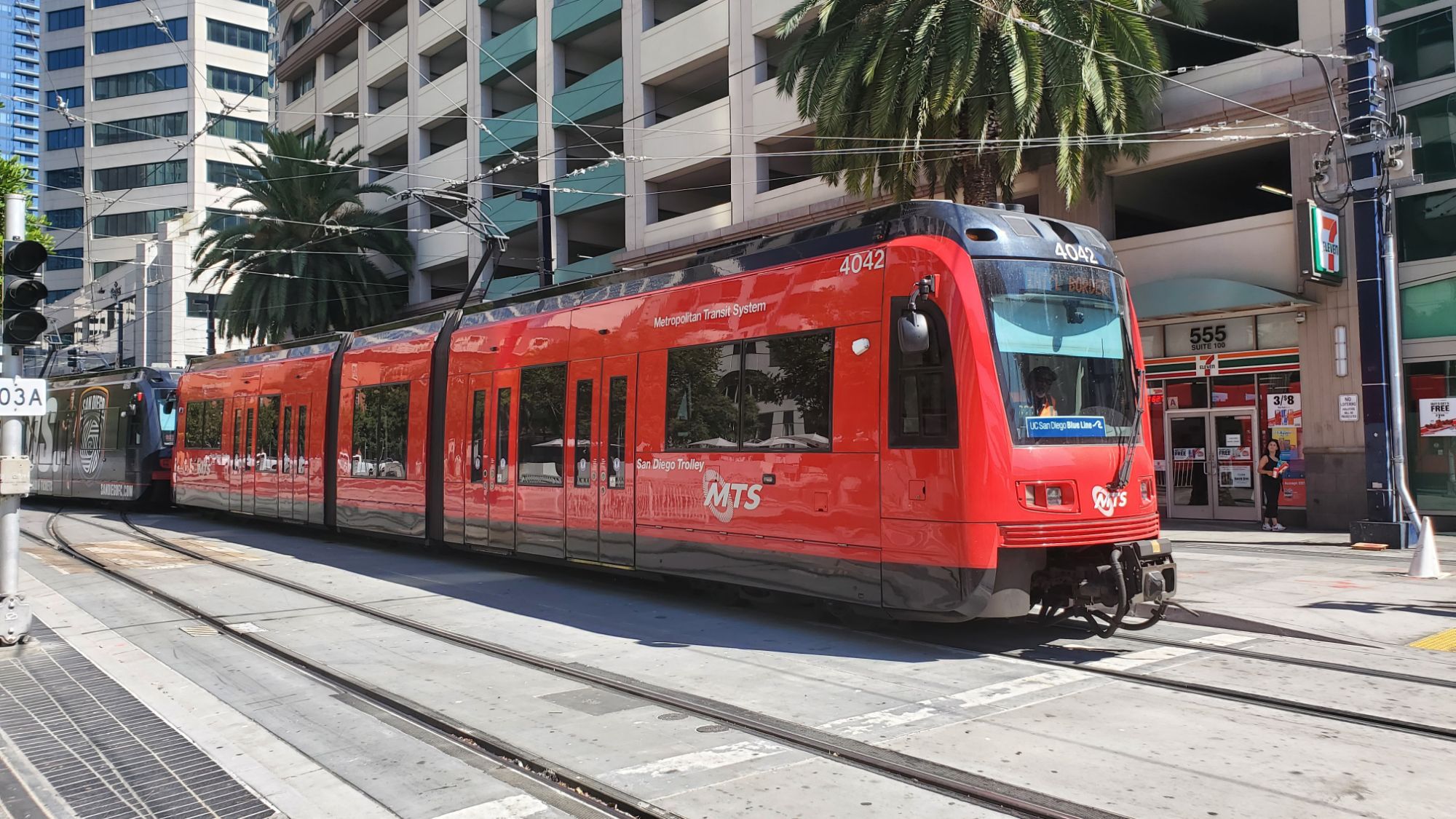
The San Diego Trolley is our light rail system that has three lines that cover a large area of the city: the Blue, Green, and Orange lines. A fourth line, the Copper Line, is a short extension connecting El Cajon and Santee. The routes take you from as far north as University Town Center in La Jolla, to the U.S.-Mexico border in San Ysidro to the south; and to El Cajon and Santee in the east.
Trains generally run about every 7 to 15 minutes depending on the line and time of day, and run from around 4:30 a.m. until midnight (depending on the specific line).
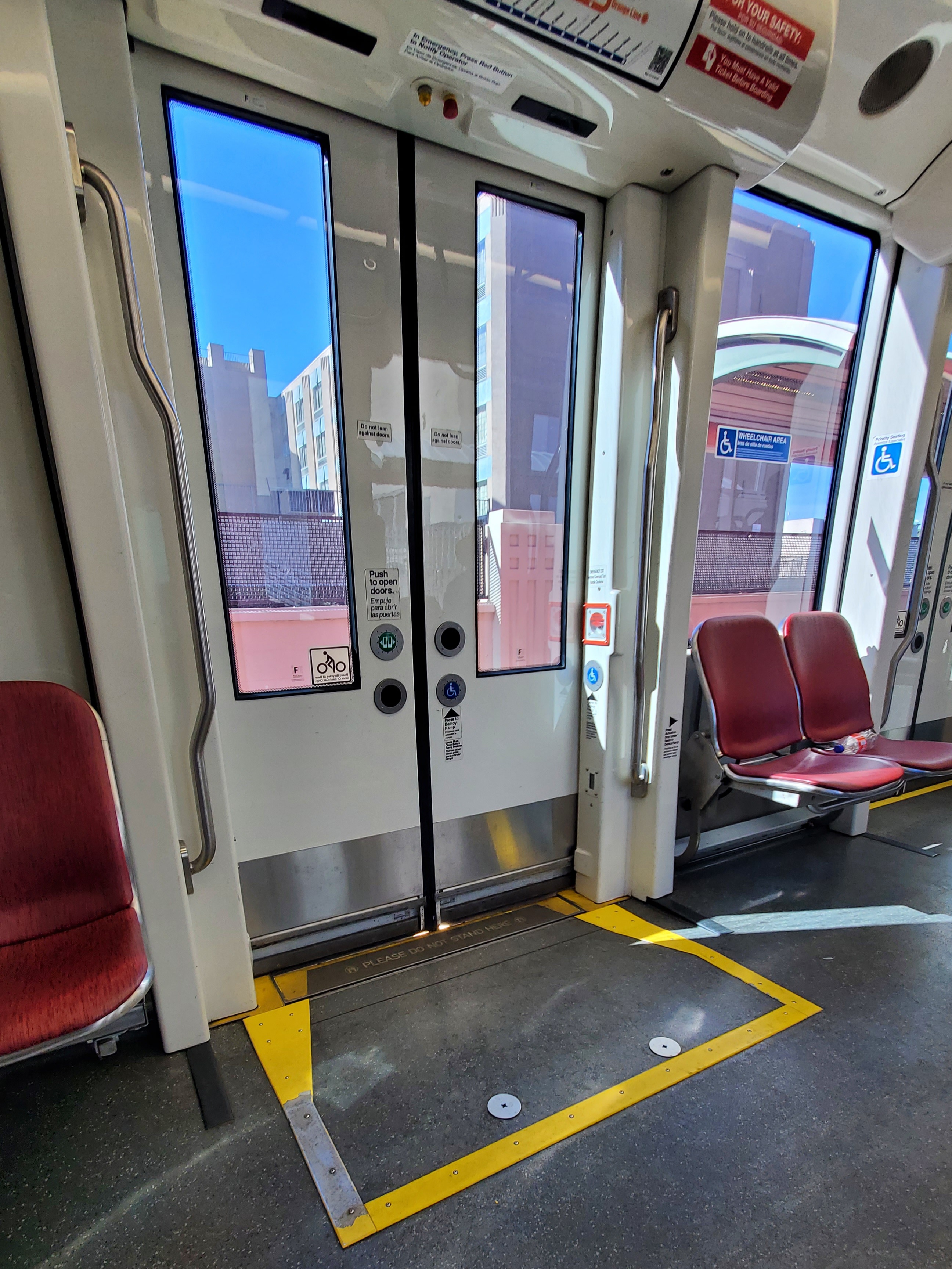
Trolleys have passenger activated deployable ramps that make them fully accessible to all users with mobility issues.
Visitors to San Diego would use the Blue or Green lines to explore many of the attractions in the area. Many of the trolley stations have connecting bus stops for buses that will get you closer to your destination.
If you use the Blue Line south of downtown and are trying to head back north, there are two versions of the Blue Line, and you will see the difference reflected on the signboards on the trolley. Trolleys with the “America Plaza” signboard will take you through downtown and terminate at the America Plaza building across the street from the Santa Fe Depot. If you wish to continue farther north on the Blue Line past the American Plaza station (to Little Italy, Old Town, or La Jolla / University Town Center), you will need to board the “UTC” trolley.


MTS Buses
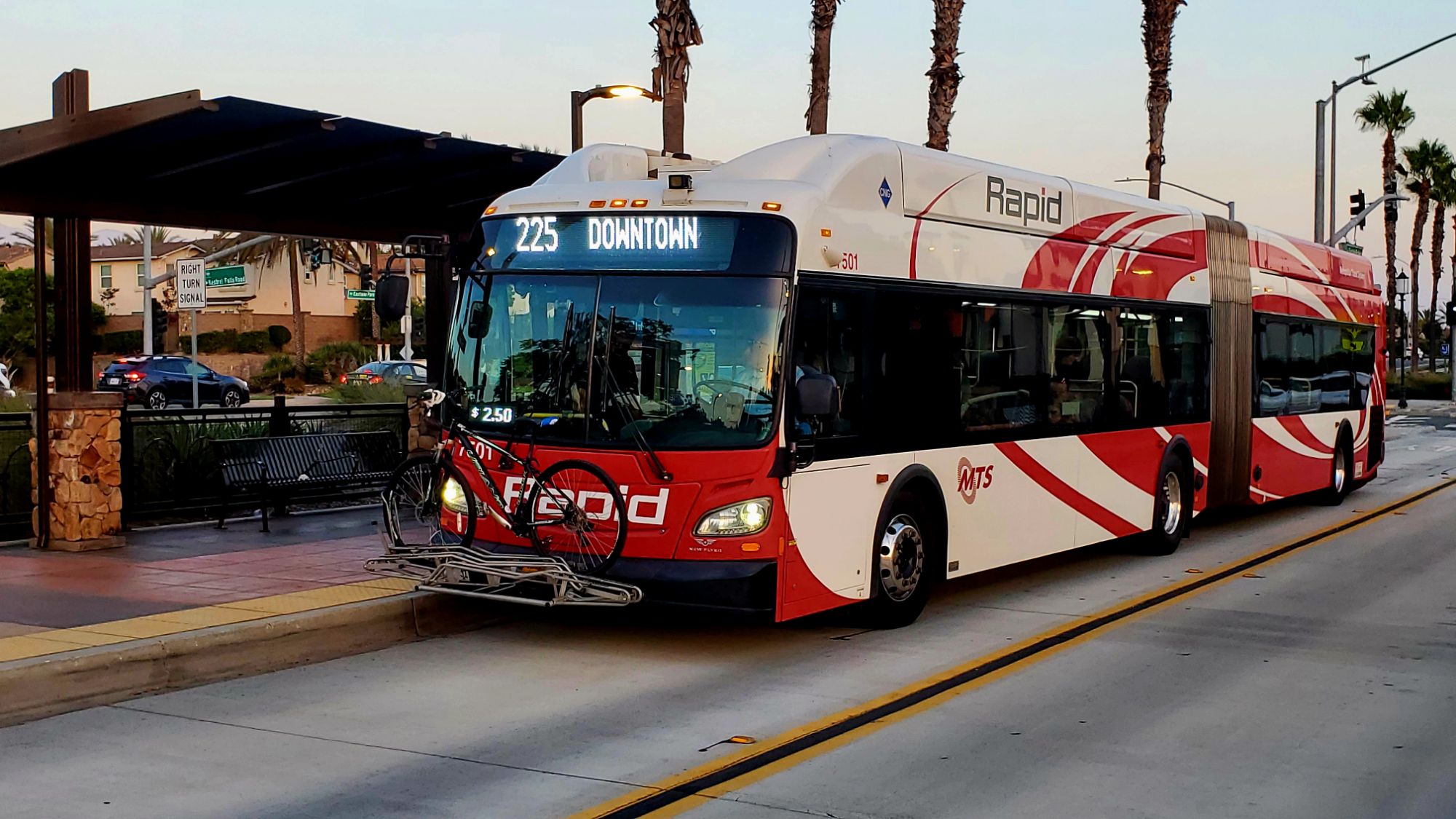
There are two types of bus service that MTS offers. First, are regular buses that make frequent stops along their routes (e.g., “milk run” routes). Second are the Rapid buses that have limited stops along their routes making them generally faster than regular buses.
Drivers can deploy a ramp for those with accessibility issues, and strap wheelchair users into a specific space reserved for them.
San Diego Flyer
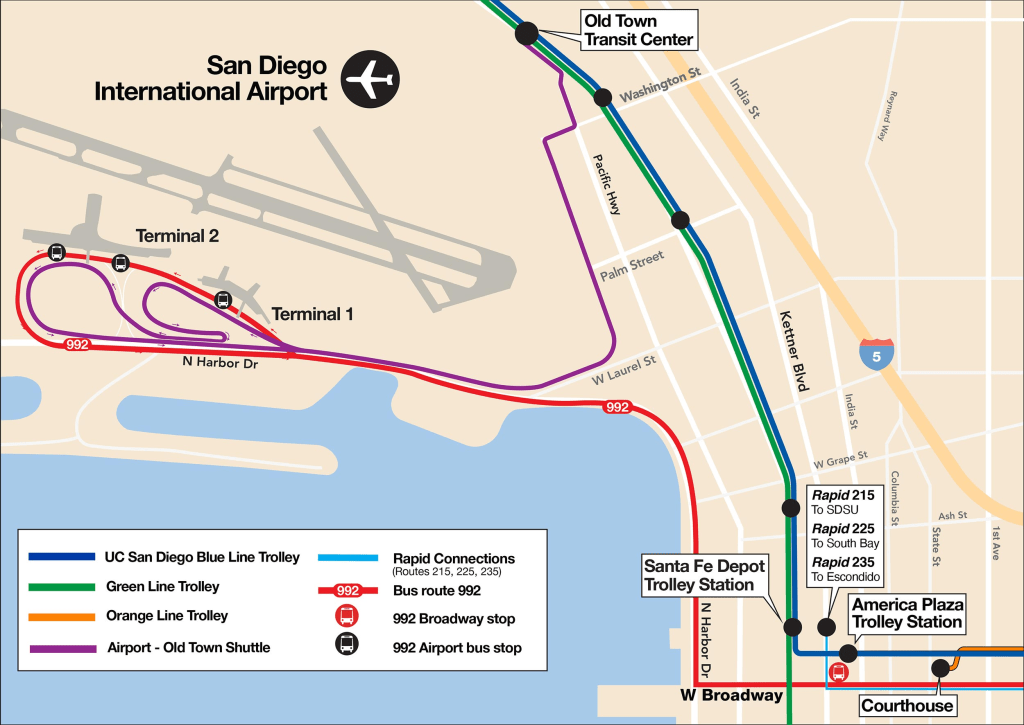
The MTS Flyer is a free shuttle service between both terminals at San Diego International Airport and the Old Town Transit Center where you can catch the Blue or Green line trolleys, Coaster, Amtrak, and many buses to other locations.
The Flyer runs from around 4:45 a.m. to 12:30 a.m. on a schedule of every 20-30 minutes.
Fares
The fare for riding the trolley or a bus is $2.50 per ride (no transfers) for adults; $1.25 per ride for seniors. Up to two children age 5 and under may ride free with a paying passenger.
The main methods of payment are Pronto, contactless payment, and cash. You can learn about the options HERE.
There are no barriers / turnstiles that you go through to board a trolley, and Transit Enforcement Officers will ride trolleys and conduct random checks to ensure you have paid your fare to ride. Enforcement will become even more strict on 1 February 2025 where you will no longer have the option to pay on the spot, and you will be cited immediately.
Pronto
SDMTS has a feature for fares known as fare-capping if you use their Pronto card or app. Fare-capping will never charge you more than a day pass ($6.00) no matter how many times you ride in the day, and you are allowed free transfers in a two-hour window of you first using the Pronto card or app.
You may purchase a reloadable Pronto card at the trolley kiosks (but not on a bus) or at retail outlets throughout San Diego. There is a one-time charge of $2.00 to purchase the physical card.
Contactless Payment
MTS just launched contactless payment options in August 2024 where you can now pay with your credit card or mobile wallet like Apple Pay, Google Pay, or Samsung Pay. If you choose to pay using these methods, you will be charged the full $2.50 fare each time you board (no discounted fare) outside of a two-hour window of your initial boarding.
Cash
You can buy trolley tickets using cash at the kiosks on the platform (up to $5.00 in change) or use exact change on the bus (no change given).
How to Ride
Riding with a Pronto card, the Pronto app, or contactless credit cards is quite simple.
For the trolley, find one of the trolley validator stands on the platform or use a kiosk, and tap your Pronto card, credit card, or mobile wallet and wait for the green check mark to appear. For the Pronto app, pull up the QR code and scan it on the bottom of the validator. For the bus, the validator is just inside the door.
You can learn how to ride HERE.
Safety
Riding MTS trolleys and buses is quite safe but, as with any transit system, you’ll want to keep your wits about you while riding. If an issue arises or you have a concern, you can call or text MTS Security at 619-595-4960.
Accessing Popular Destinations using MTS
The Santa Fe Depot downtown and the Old Town Transit Center are the two main transit centers that you would likely use to take the trolley or buses to popular destinations in San Diego. MTS has its own page on accessing popular destinations, and you can check it out here:
Popular Destinations Using MTS
Coronado Ferry
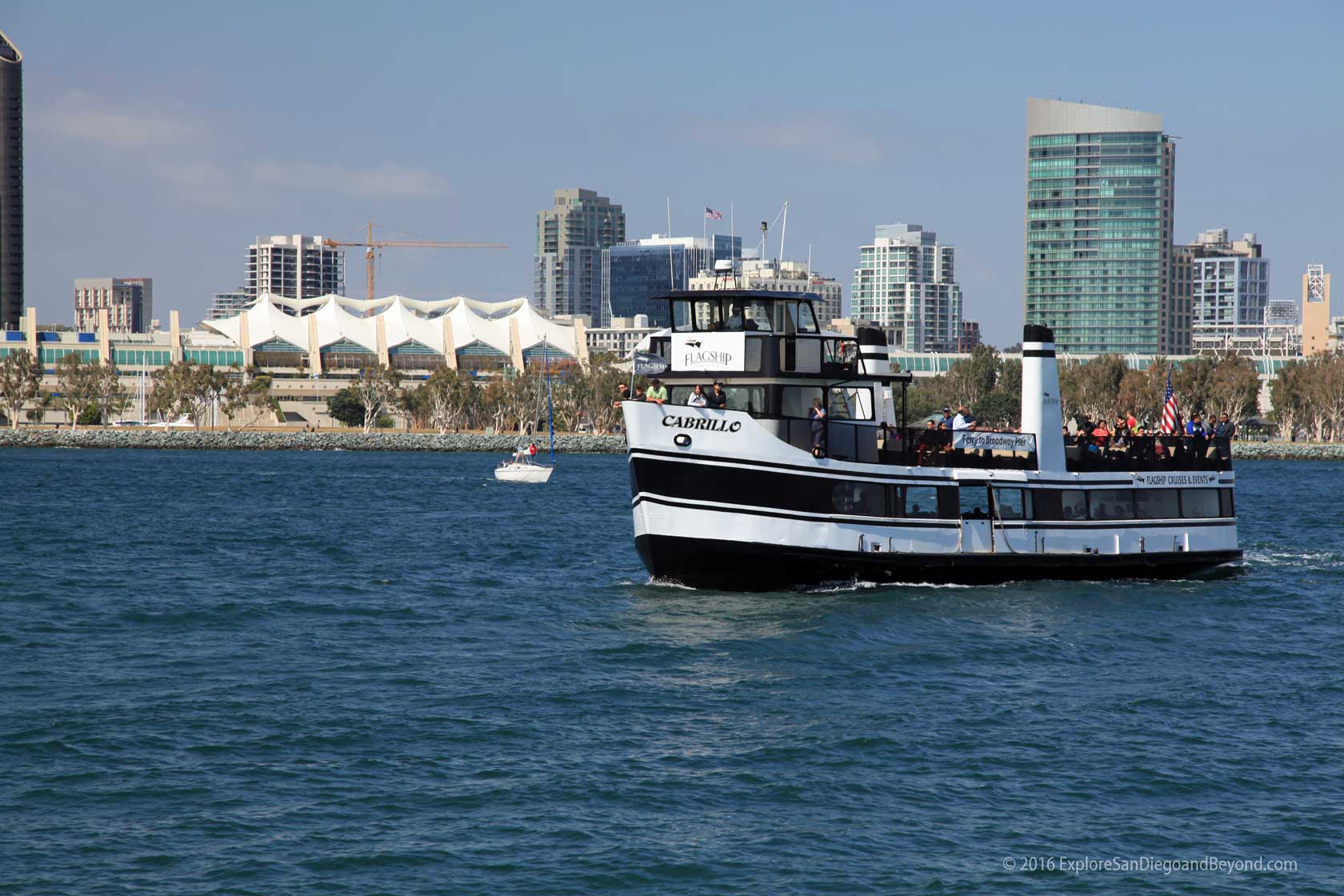
While technically not part of the MTS system, Flagship Cruises operates daily ferry service between the Broadway St. Pier or Convention Center and the Coronado Ferry Landing on Coronado. It’s a great mini harbor cruise that takes about 20 minutes to make the crossing. Ferries during the day and evening run on an hourly schedule.
When returning to the San Diego side of the harbor from Coronado, it’s important to make sure you board the correct ferry to get you to your desired location. One returns to Broadway Pier; the other returns to the Convention Center.
Fares
One-way fare for passengers age 4+ is $9.00. You can purchase tickets online, at the Flagship booth on Broadway Pier, or at the ticket kiosks. You can learn more about the ferry, its fares, schedules, and purchase tickets HERE.
Coaster Commuter Rail

The North County Transportation District provides Coaster commuter rail service between the Santa Fe Depot in downtown San Diego and Oceanside. Southbound trains run from around 5 a.m. to 10 p.m. during the week; northbound trains run from around 7 a.m. to 1 a.m. weekdays. Service is less frequent on the weekends so check the schedule.
Regarding accessibility, from the NCTD website: “All COASTER stations provide ADA-compliant level boarding through the use of bridge plates.”
Fares
The Coaster uses a zone system to charge for fares, so you will have to know which zone you’re starting in and which zone you’re ending in to calculate your fare. Fares run from $5.00 for one zone to $13.00 for three zones.
The Coaster uses the same payment methods as does SDMTS. The only difference with the Pronto card or Pronto app is that you also have to tap the validator on the platform when you get off the train so it can calculate how many zones you traveled through. If you don’t tap when you get off, you will be charged for a trip through all three zones.
You can see the Coaster fare schedule HERE.
Amtrak Pacific Surfliner

Amtrak is our national rail provider and San Diego is served by the Pacific Surfliner train that stops at the Santa Fe Depot, Old Town Transit Center, Solana Beach, and Oceanside as it makes its way north to Los Angeles and beyond (all the way to San Luis Obispo). The trains are wheelchair accessible on the lower level of the coaches.
If you are considering a trip to Disneyland in Anaheim or Los Angeles, the Pacific Surfliner may be an option for you. It’s about a 2-hour trip to Anaheim and the station is about 4 miles—a short rideshare ride or use of the ART shuttle—to the entrance of Disneyland. It’s about a 3-hour trip to the Los Angeles Union Station.
Fares
You will have to purchase your tickets through Amtrak, either at the Santa Fe Depot, on Amtrak.com, or using their app.
The fare between the Santa Fe Depot and Anaheim is $30 one-way for coach; $44 one-way for business class. If you want to go all the way to Los Angeles Union Station, the fares $36 and $55, respectively, one-way.
 Explore San Diego and Beyond ™